Answer first
A travel retail crystal jewelry product file should work as a buyer’s single source of truth for each sellable SKU or clearly defined variant. Start with an unambiguous product identity, current images, component and material descriptions, dimensions and weight as measured or otherwise documented, proposed consumer wording, care and safety notes where supported, traceability fields, and a version-controlled evidence index. It should let a buyer decide what can be listed now, what needs confirmation from an approved sample or document, and what claims must not be used. Because airport and cross-border retail may involve multiple market requirements and rapid point-of-sale decisions, do not substitute a moodboard, generic line sheet or verbal assurance for the file. Check applicable requirements with qualified advisers before market placement or publication. [1] [2]
What is the minimum decision package for a travel-retail buyer?
Ask first: can a buyer identify the exact item, assess whether its description is supportable, and send the same facts to merchandising, digital, compliance and store teams without reinterpretation? If not, the travel retail crystal jewelry product file is not decision-ready. Build it around a unique style or SKU code, revision date and declared product scope. Where a finish, stone colour or component changes, define the variant or create a separate record.
The buyer needs an evidence map: proposed retail name, facts behind it, image reference and status of every open point. Use statuses such as documented, pending buyer review, pending approved sample or not claimed. This supports an airport jewelry buyer brief without assumptions about commercial terms, availability or performance. Any unknown commercial or technical point remains subject to written quotation, applicable requirements, documentation and approved sample.
| File layer | Buyer question answered | Minimum controlled content | Decision use |
|---|---|---|---|
| Identity card | What exactly is this? | SKU, variant, product category, approved image reference | Create or hold a listing |
| Material record | What is it made of and how is it described? | Component terms, metal description, crystal or stone description, evidence status | Approve wording or request clarification |
| Risk and traceability record | Can this item be traced and reviewed? | Supplier or responsible-party fields where applicable, batch or lot field if used, issue log | Route to the relevant internal review |
| Retail copy sheet | What may appear at point of sale? | Approved name, concise description, mandatory qualifier and care wording where documented | Release copy only after approval |
Buyer checklist
- Assign a unique SKU or style code and a revision date.
- Define the exact variant scope, including what differs by colour, finish, size or component.
- Name one document owner and one approval status for each record.
- Link every hero image and product description to the relevant SKU or variant.
- Mark unknown or unverified fields rather than filling them with assumptions.
- Maintain a change log that identifies what changed and why.
How should the file identify each crystal jewelry SKU?
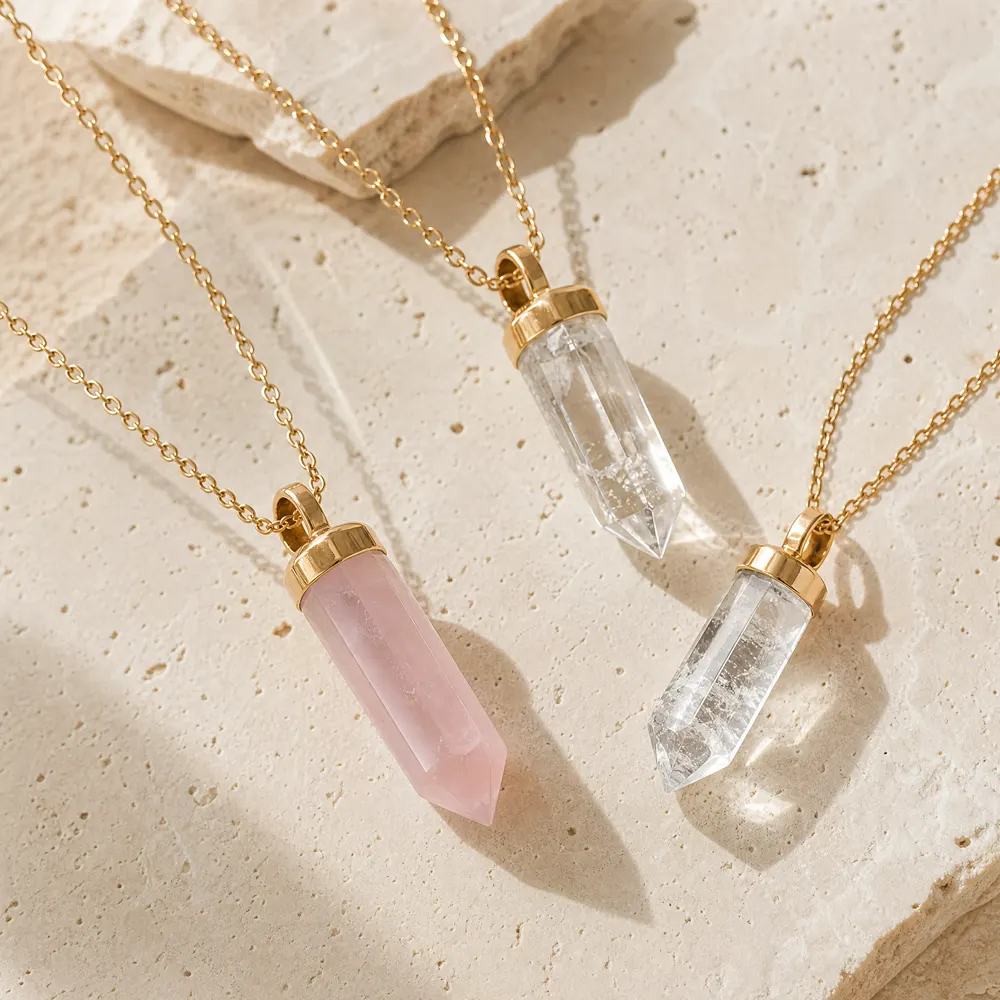
Treat the lead image as evidence of identity, not decoration. Include front, reverse or closure view where relevant, scale reference only when its method is explained, and close views of material distinctions that affect the product name. Record image filename, shoot date or approval date, the SKU shown, and whether the image is representative of a variant. If a rendering is used, label it as such and do not let it stand in for an approved physical sample.
Use measurement fields that have labels and units, not floating numbers in a description. For example, record overall length, pendant dimensions, chain length or internal diameter only as applicable, identify whether a measurement is nominal or measured, and give the method or tolerance only when documented. Product weight should similarly show the unit and whether it is the item weight, a range for a defined variant, or awaiting measurement. This discipline reduces mismatches between an image, a shelf label and a digital product page.
Buyer checklist
- Map one approved image set to each SKU or defined variant.
- State the product category and wearable configuration clearly.
- Record dimensions with units and measurement status.
- Record product weight only with its unit and defined scope.
- Describe closures, settings and detachable parts in neutral factual terms when applicable.
- Flag renderings, prototype images and representative photography.
Which material facts and construction details should be controlled?
The material block should distinguish what a component is from what it looks like. Separate base material, surface finish, plating, crystal or stone component and non-jewelry components. Do not turn appearance into a material claim: a gold-colour appearance and a gold-content statement are different data points, each requiring support.
For crystal components, use a supplier-supported material term and show whether it is confirmed, restricted or awaiting clarification. Do not collapse glass crystal, mineral crystal, gemstone, simulated stone or laboratory-created stone into one descriptor. Identify each material component. Index available drawings or component photographs, but do not state a test, certification or treatment result unless documented.
| Attribute | Control question | Appropriate evidence to index | Copy outcome |
|---|---|---|---|
| Metal description | Does the record distinguish composition from finish? | Controlled specification, approved sample record or applicable documentation | Use only the supported description |
| Crystal or stone term | Is the term specific enough to avoid misidentification? | Supplier-supported description and, where relevant, documentation | Qualify, revise or hold the term |
| Surface treatment | Is a coating, plating or other treatment represented accurately? | Controlled component information or documented specification | Describe only what the evidence supports |
| Markings | Does the artwork match the proposed claim? | Approved artwork or approved-sample observation | Do not infer a claim from an unreadable image |
Buyer checklist
- Separate base material from surface finish or coating description.
- List each consumer-facing crystal or stone term beside its support status.
- Identify mixed-material components and their location in the item.
- Record any hallmark, mark or label artwork only from controlled artwork or approved sample.
- Keep material claims consistent across the line sheet, product page and point-of-sale copy.
What claim controls belong in jewelry travel retail information?
Build a claim register before approving a product name, shelf talker or online description. Each line should show the exact proposed phrase, where it will appear, the supporting document, the owner, the market scope and the approval status. This is especially important for words that speak to material identity, origin, formation, treatment, durability, hand work, precious-metal content, grade or value. A term that sounds short and familiar can carry a specific consumer meaning, so the product file should never depend on a designer’s intention alone.
U.S. FTC Jewelry Guides say it is unfair or deceptive to misrepresent a material aspect of an industry product, including metallic content, treatment, origin, weight or character. The Guides also address disclosure of gemstone treatments when a treatment is not permanent, creates special-care requirements or significantly affects value, and require clear identification of simulated or laboratory-created stones in the situations described. Use that as a practical copy-control prompt, not as a one-size-fits-all legal conclusion for every destination. The FTC’s guidance further stresses clear, conspicuous disclosure at point of sale or in a remote sales description when applicable. Check destination-specific requirements and qualified advisers before release.
Buyer checklist
- Create a row for every consumer-facing material or craftsmanship claim.
- Record the exact qualifier that must appear with a claim, if any.
- Separate product facts from aspirational or aesthetic language.
- Do not use origin, treatment, formation, grade or value language without documented support.
- Route changes in product copy back to the file owner for version review.
How should traceability, safety evidence and market mapping be structured?
A buyer needs a retrievable trail, not an attachment bundle. Give the file a document index with title, identifier, date, issuer or owner, SKU scope, version, status and storage reference. Separate supplied documents from buyer-created copy, requested documents from received documents, and approved-sample observations from supplier statements. If a record is absent, say absent or pending; do not create a derived conclusion.
In EU context, Article 9 of Regulation (EU) 2023/988 requires manufacturers to undertake an internal risk analysis and technical documentation with product description and relevant safety characteristics before market placement. As applicable it includes risk analysis, mitigations, test outcomes and standards; documentation must be kept available to market-surveillance authorities for 10 years. This buyer tool is not a compliance declaration; map the destination and local label or language issues for qualified-adviser review.
| Buyer situation | File test | Action before copy release |
|---|---|---|
| A product will be considered for several destinations | Does the file show which requirements have been checked for which market? | Assign market review; do not treat one market’s review as universal |
| A technical or safety document is requested | Is the document ID, SKU scope and current status traceable? | Provide the indexed document or retain the item as pending |
| The approved sample differs from existing artwork | Does the change log identify the affected claim or image? | Stop the affected copy and reconcile to the approved sample |
| A material question cannot be documented | Is the consumer term being inferred? | Remove, qualify or hold the claim pending documentation |
Buyer checklist
- Create an evidence index with document ID, date, owner, scope and status.
- Link each risk, safety or compliance question to a document or an explicit open item.
- Record the intended market or channel as a review field, not an automatic approval.
- Capture the responsible economic-operator information where applicable and documented.
- Keep a dated record of copy changes and evidence updates.
- Escalate conflicting supplier, sample and artwork information before listing.
Which operational data makes an airport review faster without creating unsupported promises?
Operational fields should reduce hand-offs, not broaden the product story. Include product category, assortment family, SKU-to-image mapping, language version, proposed retail name, short and long description status, and internal contact or escalation path. Add a clean distinction between confirmed data, buyer-specified fields and pending fields. A buyer can then see quickly whether a product has the information needed for a particular listing workflow without inferring price, minimum order quantity, capacity, lead time, inventory, delivery or other unprovided commercial terms.
Use the same controlled wording in the data export, image folder and approval sheet. If the retail team needs a concise description, generate it from the approved claim register rather than rewriting from memory. If local adaptation is requested, retain both the master wording and the localized version with a reviewer and date. This is the practical value of crystal product data for retail: it creates a deliberate route from product evidence to consumer communication, while leaving unknown details visibly unresolved.
Buyer checklist
- Add a clear content status for retail name, short description and long description.
- Keep approved master copy and each localized version together with revision dates.
- Use an escalation contact for data questions, not untracked chat messages.
- Show whether an image, copy field or artwork is approved, pending or superseded.
- Exclude unconfirmed commercial or service statements from the product file.
What should the buyer ask before approving a listing or request for quotation?
The most useful duty free jewelry sourcing questions are evidence questions. Ask what this SKU is, which exact variant the images show, which words the seller wants the consumer to see, and what document supports each material-sensitive word. Then ask which fields are confirmed by the approved sample and which remain subject to documentation. The aim is not to demand every possible certificate; it is to decide whether the available evidence matches the intended claim and the buyer’s applicable review process.
Use a short gate before releasing a listing: identity complete, material terminology controlled, claims reviewed, evidence index current, and unresolved gaps visible. A request for quotation can proceed under the parties’ written process, but should not silently convert provisional product data into approved consumer claims. This distinction protects accuracy when an assortment is still being evaluated and makes later content updates auditable.
Buyer checklist
- Which SKU and variant does every image and description represent?
- Which proposed consumer claims are supported by documents or approved sample evidence?
- Are crystal or stone terms precise about material identity and formation where relevant?
- Are any treatment, special-care, grade, origin or value statements proposed, and what supports them?
- Which documents are current, pending, superseded or not available?
- What market, language and internal approval checks remain before publication?
Frequently asked questions
Is a line sheet enough for airport jewelry review?+
Usually no. A line sheet can introduce a range, but a decision-ready product file connects each SKU or defined variant to images, material terminology, claim status, evidence references and version control. Use the line sheet as an index, not as the only record.
What should a buyer do if a crystal or stone label is unclear?+
Hold the consumer-facing term at a neutral, supported level and request documentation or clarification. Do not upgrade a vague term into gemstone, mined, laboratory-created, treated or origin language without support. Confirm the final wording against applicable requirements and qualified advisers.
Should treatment information be in the product file?+
Yes, when treatment information is documented or a treatment question is relevant to the proposed description, care or market review. Record the source, the exact wording and whether disclosure or special-care wording is pending. Do not state a treatment status that has not been documented.
How often should the file be updated?+
Update it whenever the SKU scope, material description, image, consumer claim, controlled artwork, supporting document or approved-sample observation changes. Retain a dated revision history so a buyer can identify which version governed a listing decision.
Conclusion
A strong travel retail crystal jewelry product file is a controlled decision record, not a promotional brochure. It makes SKU identity, material terminology, proposed claims, evidence and unresolved questions visible in one place. Require the same discipline from first review through copy release: use documented facts, distinguish pending points, and confirm applicable market requirements with qualified advisers before publication or market placement.
Product category references
Explore relevant GemMira formats.
Next step
Move from general guidance to your specific brief.
For a GemMira wholesale, private-label, or custom inquiry, share the product category, market, material direction, and any available reference images. Commercial terms, final specifications, and sample options are confirmed in a quotation and approved pre-production sample. Email your requirements to info@gemmira.com.
Start an inquiry with this guide →Email info@gemmira.com