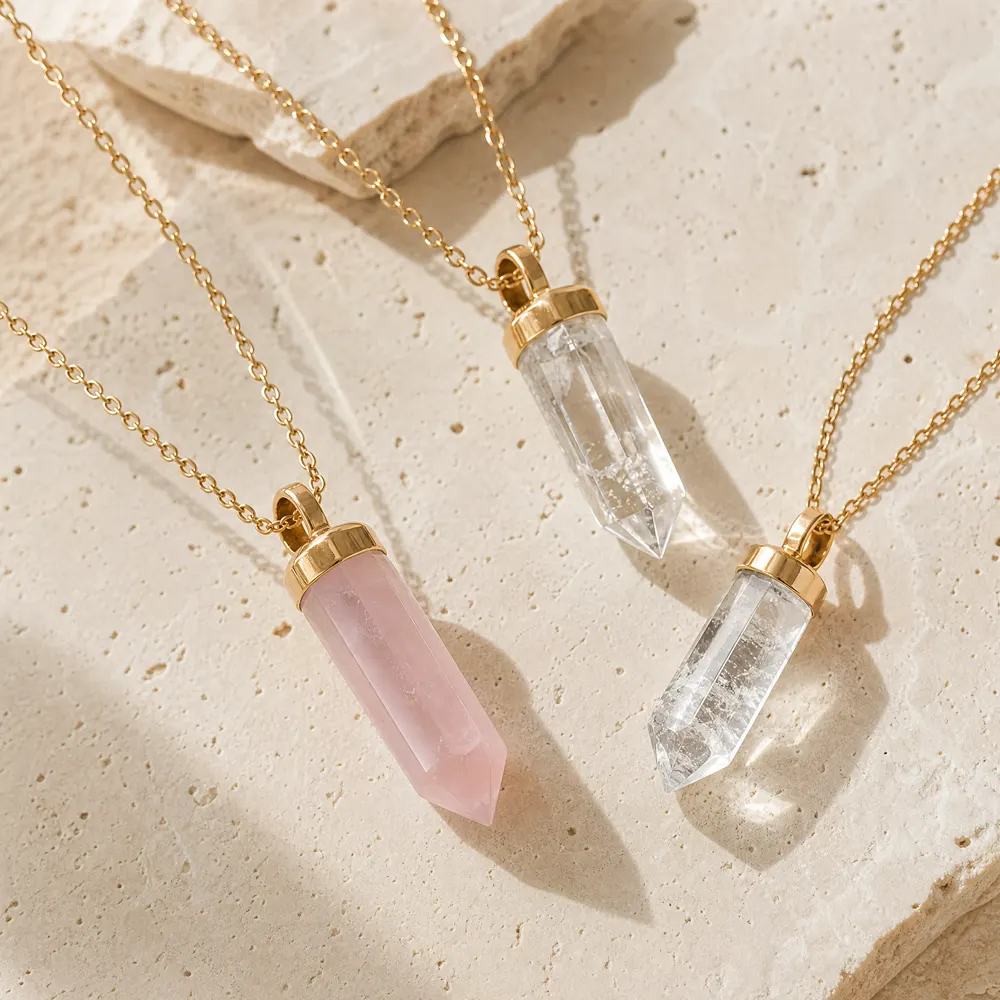
Answer first
A retail team should receive one approved, SKU-level product brief that distinguishes what the crystal component actually is, how it was made or altered, what the metal and construction are, what care is appropriate, and which claims are permitted or prohibited. The brief should be tied to supplier documentation and an approved sample, rather than relying on a product name, colour or sales story. Where material identity, treatment, origin, plating, durability or test status is not documented, staff should say so and escalate rather than infer. This matters because descriptions such as “crystal,” “natural,” “gemstone,” “lab-created,” “treated” and “imitation” are not interchangeable. In the United States, the FTC Jewelry Guides address clear disclosure of qualifying gemstone treatments and distinctions between mined, laboratory-created and imitation stones; other destination markets have their own requirements. Treat the brief as a controlled internal record and have applicable claims, labelling and consumer-information requirements reviewed by qualified advisers before sale. [1] [2]
## 1. Start with a material identity statement, not the word “crystal”
The first question for a buyer is: **what is the decorative component, precisely?** “Crystal jewelry” can be a merchandising category rather than a gemological description. A sales team needs the approved material term for each SKU: for example, a natural mineral specimen, a named gemstone, glass crystal, laboratory-created material, a composite, resin, or another manufactured component. Do not let staff translate an ambiguous product title into “natural stone,” “gemstone,” or a named mineral without documentary support.
Build the description from the component outward. Record the trade or material name supplied, the form (bead, cabochon, faceted stone, point, inlay or coating), whether the component is single material or assembled, and the setting or carrier material. A photograph is useful for recognition, but it is not evidence of identity or treatment. The U.S. FTC Guides caution against using a gemstone name for a product that is not the mined stone unless the nature of the product is clearly disclosed; the Guides are a useful clarity benchmark even when the retail destination is elsewhere.
Buyer checklist
- Obtain the exact component material name used in supplier records.
- Record the SKU, component form, colourway and material placement.
- Separate decorative-component terminology from the metal, coating and findings description.
- Flag generic terms such as “crystal,” “stone” or “natural” for clarification before copy approval.
- Keep the approved sample reference with the SKU record.
## 2. Give staff a plain-language disclosure route for natural, laboratory-created, imitation and composite materials
A productive crystal jewelry product knowledge brief makes classification usable at the counter. Staff do not need to diagnose materials; they need a precise approved phrase and a route to the underlying record. The key distinction is whether the item is a mined/natural material, a laboratory-created material with the stated properties, an imitation or simulated material, or a material combined with filler, binder, backing or other components. If the documentation does not answer that question, the product description should be held or limited to what is documented.
The decision is commercial as well as editorial. A customer may ask whether a component is “real,” but that word is too imprecise to resolve a classification issue. Train staff to replace it with a neutral clarification: “I can confirm the material description shown on this SKU record.” For U.S.-directed claims, the FTC specifies that laboratory-created or imitation stones need clear, equally conspicuous qualification when used with a natural stone name, and says “faux” alone is not adequate disclosure. Check the requirements that apply in each sales market before finalising wording.
| Documented category | What the sales team may say | What must be checked before release |
|---|---|---|
| Natural/mined material | Use the approved material name; do not add origin, untreated status or rarity unless documented. | Identity wording, any origin claim, treatment disclosure and market-specific labelling. |
| Laboratory-created material | Use the approved laboratory-created or laboratory-grown wording where substantiated. | Whether the named comparison material is appropriate and whether required qualifiers are clear. |
| Imitation/simulated material | Use the approved imitation or simulated description; do not imply it is a mined gem. | Conspicuousness of the qualifier across labels, e-commerce and verbal scripts. |
| Composite or material with filler/binder | Describe the item only with approved qualified terminology and care direction. | Composition, special-care needs, durability information and any restrictions on the base name. |
Buyer checklist
- Provide one approved customer-facing material sentence per SKU.
- State whether the classification is supplier-declared, document-supported or independently reported—without overstating it.
- Prohibit staff from substituting “natural,” “synthetic,” “crystal” or “gemstone” casually.
- Route uncertain classification questions to the product-data owner.
- Align online title, shelf label, pack copy and staff brief to the same approved term.
## 3. Make treatment disclosure and care part of the same training module
Ask a direct buyer question for every relevant component: **Has it been treated, coated, dyed, irradiated, impregnated, filled, heated, assembled or otherwise modified beyond ordinary cutting and polishing?** The response should identify the treatment in the supplier’s documented terminology, its effect where known, whether special care is stated, and the evidence reference. Do not infer that a material is untreated because no treatment is visible; the Gemological Institute of America notes that treatments can alter colour or clarity, may affect durability, and are not always apparent even to experts.
Treat disclosure and care as one record because the commercial risk often appears after the sale. The FTC Jewelry Guides state that treatment disclosure is required in circumstances including non-permanence, special-care requirements or a significant effect on value, and its note applies the disclosure principle at every level of trade. The exact legal obligation depends on the market and facts, so the operating rule for a multi-market retailer is conservative: preserve the treatment statement, map it to customer-facing copy, and do not omit the associated care limitation.
Buyer checklist
- Capture each declared treatment or modification verbatim, with document date and source.
- Record whether a care limitation or permanence statement is supplied.
- Confirm the approved consumer disclosure location for each retail channel.
- Do not describe a treatment as permanent, stable or undetectable unless documented for that SKU.
- Escalate any mismatch between the sample, supplier record and proposed product copy.
## 4. Teach construction, metal and wear information separately from the crystal story
Crystal-component knowledge is incomplete if it omits the rest of the product. The staff brief should identify the base metal or material, fineness or grade only where documented, plating or coating if declared, fastening type, setting method, stringing or adhesive dependency, and removable elements. This lets the team answer practical questions without converting a visual description into an unsupported quality claim. If a hallmark, stamp or label is present, record exactly what it says and verify what it may mean in the intended market before training staff.
Care language should be bounded by evidence. For example, a brief can say “follow the approved care card” when detailed handling limits have not been documented; it should not promise water resistance, tarnish resistance, hypoallergenic performance, scratch resistance or longevity without substantiation. Keep cleaning advice product-specific. If the component is declared coated, porous, assembled or adhesive-set, ask for written care directions and use only the directions approved for the SKU.
Buyer checklist
- List component materials and finishes by SKU, including findings and closures.
- Record declared plating/coating and whether a thickness or durability statement is actually documented.
- Add approved wear, storage and cleaning instructions—or an escalation flag where absent.
- Exclude allergy, water-resistance and durability promises unless substantiated for the finished product.
- Ensure sales scripts do not overwrite the care card or approved data sheet.
## 5. Build an evidence pack that the buyer, copywriter and store trainer can all use
The best retail jewelry product guide is traceable. For each SKU or tightly controlled product family, attach the supplier specification, component declaration, treatment statement where relevant, metal/finish declaration, approved sample reference, artwork or label proof, care text, and internal approval date. Assign a version number and owner. The point is not to manufacture certainty: it is to show what is known, who stated it, which version is current, and which questions remain open.
Set a hierarchy for language. Supplier documentation and approved samples may support basic product description; formal reports or test records, if supplied and applicable, should be retained exactly as issued; marketing claims should never be elevated beyond the underlying evidence. The CIBJO Blue Books describe voluntary, regularly reviewed standards for nomenclature and grading across gemstones, precious metals and related categories. They can help teams seek consistent terminology, but they do not replace applicable law, product testing or professional advice.
| Field | Evidence to retain | Staff-facing use |
|---|---|---|
| Material identity | Supplier material declaration and approved sample reference | Approved product name and clarification script. |
| Treatment/modification | Dated declaration and any applicable report | Disclosure wording and care escalation. |
| Construction and finish | Specification sheet, component list and label proof | Wear, closure and basic composition questions. |
| Claims control | Approved copy plus substantiation reference | Permitted statements and prohibited claims. |
Buyer checklist
- Create a single source-of-truth folder or product-information record for each SKU.
- Link every approved claim to a specific document, sample or qualified report.
- Date-stamp supplier declarations and record the party that supplied them.
- Keep unverified origin, treatment and performance fields visibly marked as unknown.
- Version-control any copy or care instruction changed after approval.
## 6. Turn the data into a short, repeatable store briefing
A crystal jewelry staff briefing should be short enough to use, but structured enough to prevent improvisation. Start with a one-minute SKU introduction: material identity, visible design features, construction facts, approved care message and the correct disclosure sentence. Then rehearse the three questions customers are most likely to ask: “What is it made of?”, “Is it natural or treated?”, and “How should I care for it?” Staff should answer from the SKU brief, not from general crystal folklore or personal beliefs.
Use an escalation rule for every uncertain answer: pause, consult the product record, and refer the question to the designated product-data or compliance owner. This is especially important for country of origin, medical or wellbeing assertions, spiritual or energy language, testing, certification, metal-sensitivity claims, and durability promises. Do not validate health, healing, medical or wellness outcome, medical, spiritual, energy or feng-shui efficacy claims. A polite factual response protects the customer conversation while keeping claims within approved evidence.
Buyer checklist
- Issue a one-page SKU card and maintain a fuller source record behind it.
- Train a standard response to material, treatment and care questions.
- Include a clear “do not say” list for unsupported claims.
- Give staff the name or channel for escalation before launch.
- Refresh the briefing whenever the supplier declaration, composition or copy changes.
## 7. Use a buyer release gate before product data reaches the sales floor
Before approving training, ask whether the product record can withstand a simple handover: can a new colleague identify the component, repeat the approved material description, find the treatment and care statement, and explain what is still unknown? If not, the team does not yet have a sellable knowledge brief. Release can be conditional only when the unresolved issue is removed from the claim set and the applicable requirements permit the product to be offered; seek qualified advice where rules are unclear.
For B2B buyers working across Europe, North America and the Middle East, do not assume one wording travels unchanged. Destination-market rules, language, hallmarking, consumer-information and advertising expectations may differ. Use the global source record as the base, then create market-specific labels and scripts after checking applicable requirements and consulting qualified advisers. This is operational guidance, not legal advice.
A practical release gate also prevents a common handover failure: the buying file contains a claim, but the store team sees only a product name and image. Publish the approved customer-facing sentence, care note and escalation link in the same system or pack used for launch. Before rollout, test one record with a colleague who did not source the item. If that colleague cannot answer using the documented record, simplify the briefing or obtain the missing documentation rather than expanding the sales narrative.
Buyer checklist
- Confirm the final SKU code, photo and approved sample are linked to the same record.
- Verify that material and treatment wording is consistent across all sales channels.
- Check that care information is available wherever the product is presented.
- Remove unsubstantiated origin, efficacy, performance and certification language.
- Obtain internal sign-off from the accountable product-data and market-review owners.
- Archive the released version and retain change history.
Frequently asked questions
What is the minimum information a sales associate needs for a crystal jewelry SKU?+
At minimum: the approved component material description; whether any relevant treatment or modification is declared; the metal/finish and construction facts that are documented; approved care language; permitted claims; and a named escalation contact. Add the evidence reference so the associate is not asked to rely on memory.
Can staff call every crystal component a gemstone?+
No. Use the term only where the documented material and applicable market requirements support it. “Crystal” may describe a retail category or appearance rather than a specific mineral or gem material. Where the component is laboratory-created, imitation, composite or otherwise manufactured, use the approved qualified description instead.
What should happen when treatment information is missing?+
Do not guess from colour, price or appearance. Request a written supplier statement, keep the treatment field marked unknown until resolved, and have the product-data owner decide whether copy must be restricted, the item must be held, or market-specific review is required. Do not tell customers an item is untreated without support.
Should a supplier certificate be shown as proof of every sales claim?+
Not automatically. Retain the document, identify what product or component it actually covers, check its date and issuer, and use only claims the document supports. A certificate, report or supplier declaration does not itself authorise broader origin, performance, treatment, health or quality language.
Conclusion
A useful crystal jewelry product knowledge brief is an evidence-controlled handover: material identity, classification, declared treatments, construction, care, approved wording and an escalation path. Obtain the facts in writing, link them to the correct SKU and sample, localise the final claims for the relevant market, and leave unsupported statements out. That gives retail teams a factual way to serve customers without overpromising.
Product category references
Explore relevant GemMira formats.
Next step
Move from general guidance to your specific brief.
For a GemMira wholesale, private-label, or custom inquiry, share the product category, market, material direction, and any available reference images. Commercial terms, final specifications, and sample options are confirmed in a quotation and approved pre-production sample. Email your requirements to info@gemmira.com.
Start an inquiry with this guide →Email info@gemmira.com