Answer first
An earring pair and single-unit selling brief should state exactly what the customer receives, what one SKU and one order quantity mean, how left and right pieces are identified, and how that same configuration appears in packaging, photographs, product data, purchase orders and shipping documents. Treat “pair” and “single” as controlled selling terms, not assumptions; release only wording and images that match the approved sample and applicable market requirements. [1] [2]
1. Set one controlled meaning for the sellable unit
Start with a simple distinction: the physical component is one earring, while the sellable unit may be one pair, one individual earring, a left-only replacement, a right-only replacement, or another expressly defined configuration. The brief should name both quantities. For example, “retail unit: 1 pair; physical contents: 2 earrings” is less ambiguous than “qty: 1” or “2 pcs” alone.
Make this choice before a SKU is created. The same approved configuration should drive the order line, carton count, barcode allocation, online title, product-page bullets and returns handling. If a collection includes a single earring option, define whether it is a customer-facing retail offer, a service-only item, or not offered; do not let a photography crop or warehouse shorthand make that decision by accident.
Buyer checklist
- State the retail unit of sale as “pair,” “single earring,” “left,” “right,” or another controlled term.
- State the number of physical earrings included in one sellable unit.
- Record whether left and right pieces are interchangeable, handed, or not applicable.
- Assign one approved configuration owner on the buyer side before sample sign-off.
2. Choose the configuration before SKU, imagery and retail copy are released
Use a decision table to prevent a pair-based listing from being supplied, photographed or received as individual units. A seller-facing brief does not need to dictate a supplier’s system; it needs to identify the buyer’s approved sellable configuration and the evidence that will be checked against it.
Where a design is asymmetric, attach a front-view reference that labels left and right from the wearer’s perspective. Where the two pieces are identical, say so rather than leaving the issue blank. Do not use terms such as “set,” “pair,” “piece,” “unit,” or “quantity” interchangeably without defining them for that SKU.
| Selling configuration | Customer receives | SKU and image wording to approve | Decision needed before release |
|---|---|---|---|
| One pair | Two earrings as one retail unit | “1 pair (2 earrings)” with an image that shows both pieces | Are the two pieces identical or wearer-left/wearer-right? |
| One single earring | One earring as one retail unit | “1 single earring” and a clear one-piece image | Is the offer deliberately consumer-facing, and is side selection needed? |
| Left-only or right-only | One designated handed earring | “Left earring only” or “Right earring only”; use a labelled orientation image | Which orientation convention is used, and does it match the approved sample? |
| Replacement or service unit | One defined component under a controlled process | Internal/service description distinct from the retail listing | Is it orderable by retailers, consumers, both, or neither? |
| Multi-pair pack | The stated number of pairs | “[X] pairs / [Y] earrings” with all contents disclosed | Are pack-level SKU, barcode and carton quantities separately controlled? |
Buyer checklist
- Approve the exact noun used in the title and order line: pair, single, left, right or multi-pair pack.
- Approve a wearer-perspective convention for any handed style.
- Require the sample, photo selection and sellable-unit wording to be reviewed together.
- Keep service or replacement units distinct from retail SKUs unless the commercial brief says otherwise.
3. Reconcile SKU, order, pack and import-document quantities
Build a quantity crosswalk for every configuration: retail SKU; units ordered; physical earrings; inner-pack contents; master-carton contents; and invoice description. It should be possible to trace one purchase-order line to the count received without converting a “pair” into an implied “piece.” If the order is 100 pairs, the crosswalk can record 100 retail units and 200 physical earrings, subject to the approved configuration and packing record.
For U.S.-bound imports, the commercial-invoice rules require a detailed merchandise description, quantities in relevant weights and measures, package marks and numbers, country of origin, and adequate detail about what each individual package contains. [19 CFR 141.86](https://www.ecfr.gov/current/title-19/chapter-I/part-141/subpart-F/section-141.86) is a useful reason to align the invoice, packing list and approved SKU description early; the importer and customs broker should confirm the entry-specific wording and data.
Buyer checklist
- Map each PO quantity to both retail units and physical earring count.
- Keep SKU, barcode, packing-list and invoice descriptions under version control.
- State inner-pack and master-carton quantities only after they are confirmed in writing for the order.
- Ask the importer or broker to review document fields for the destination transaction.
4. Make packaging, photography and e-commerce data prove the same offer
Packaging should make the selling configuration readable at the point of receipt and, where relevant, at the point of sale: SKU, unit descriptor, physical count where helpful, and side designation for asymmetric pieces. A packaging mock-up is evidence of presentation, not proof of a material, origin, treatment, safety or performance claim. Those claims should appear only when supported by applicable documentation and approved wording.
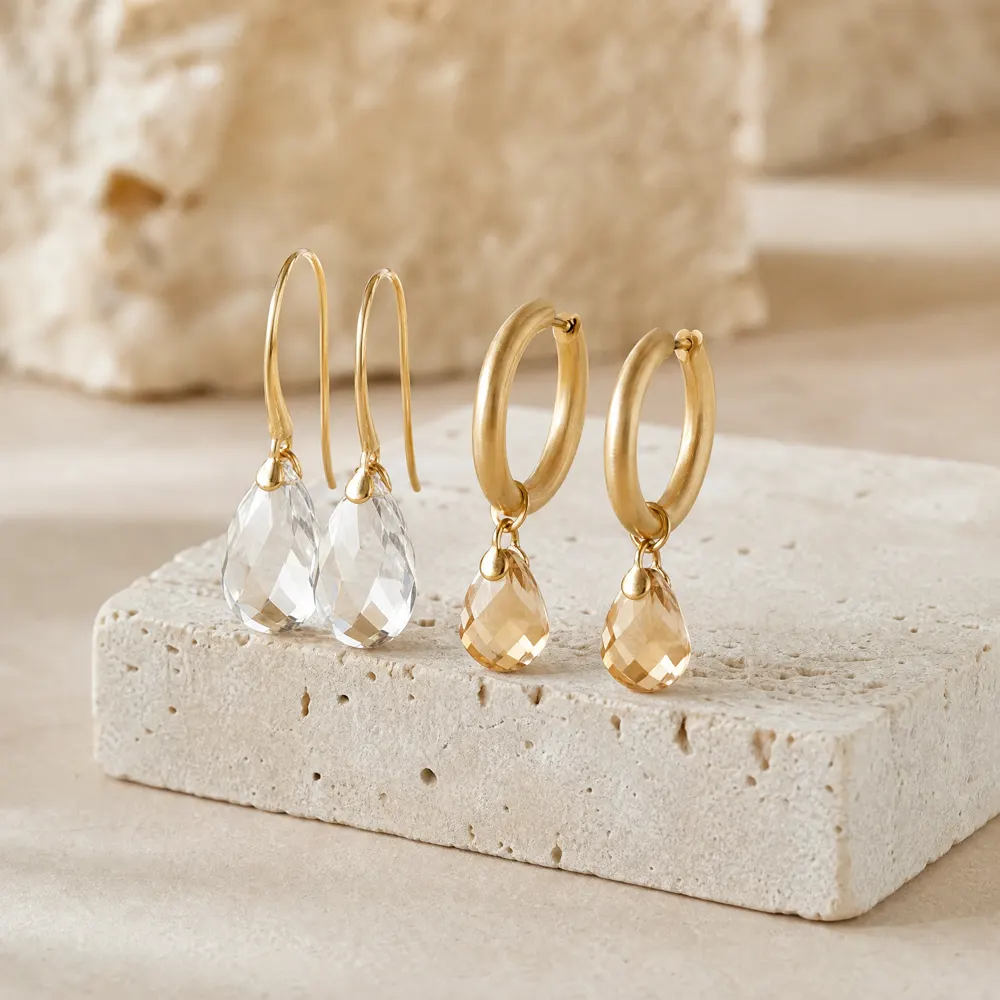
Set a minimum image set around the approved configuration: a primary image showing the complete contents of the sellable unit, an orientation image when handedness matters, and close detail only when it cannot create a misleading impression of the quantity. The U.S. FTC Jewelry Guides state that misrepresenting quantity, size, material aspects and other material characteristics of jewelry industry products can be deceptive; the guide also cautions that an image showing a gemstone larger than actual size may mislead without a true-size disclosure. Review the net impression of images and copy, not isolated labels.
Buyer checklist
- Show the complete customer-received configuration in the primary product image.
- Use a labelled orientation image for left/right styles where needed.
- Check that title, bullets, package artwork, alt text and image count use the same unit term.
- Escalate material, gemstone, metal, origin, treatment and size statements for evidence-based approval.
5. Separate product-identification duties from commercial shorthand
A pair/single brief supports traceability, but it does not replace the legal product-information assessment for each market. For consumer products placed on the EU market, Article 9 of the [EU General Product Safety Regulation](https://eur-lex.europa.eu/eli/reg/2023/988/oj/eng) requires manufacturers to ensure products bear a type, batch or serial number, or another identifier that is visible and legible; where size or nature prevents this, the information may be on packaging or an accompanying document. The same Article addresses manufacturer contact information and, where needed, instructions and safety information. Confirm the applicable roles, language and category-specific requirements with the responsible compliance function.
A retail unit descriptor such as “1 pair” should therefore be its own controlled data field, alongside—not substituted for—the product identifier, batch/lot reference where applicable, and required operator information. For jewellery claims in U.S. marketing, the FTC guides apply across the trade and identify misleading representations about, among other things, quantity, metallic content, size, colour, treatment and origin as a concern. Do not add unsupported qualifiers merely to make a single-unit offer sound more premium.
Buyer checklist
- Identify the destination market and responsible reviewer before finalising consumer-facing labels.
- Keep the sellable-unit term separate from product identifier and any approved batch or lot record.
- Confirm language, safety and economic-operator information against applicable requirements.
- Approve only claims that are supported by the relevant written documentation and approved sample.
6. Release with a one-page earring selling-configuration record
Create a one-page release record for each SKU or configuration variant. It should capture: style name and internal reference; pair/single/handed status; retail and physical counts; approved sample reference; title and short description; packaging artwork version; image filenames; order-line unit; and open points. Link the record to the written quotation, approved sample and destination-market review rather than assuming commercial or technical terms.
Use the record again at receiving. If contents, orientation, SKU labeling or imagery do not match the approved configuration, quarantine the discrepancy in the buyer’s internal process and document the units, photos, packaging version and relevant order references for follow-up. This creates an evidence trail without presuming cause, liability, replacement availability or any commercial outcome.
Buyer checklist
- Obtain buyer approval for one written configuration record per SKU or variant.
- Attach approved sample references, current image filenames and artwork versions.
- Confirm any order-specific pack data, commercial terms and documentation by written quotation.
- At receipt, compare the sellable configuration against the PO, packing list and approved record before listing or allocation.
Frequently asked questions
Can “pair” be used as the purchase-order unit while warehouse counts use individual earrings?+
Yes, if the crosswalk explicitly shows both. State the PO unit as “pair,” the physical count as two earrings per pair, and the applicable SKU, pack and carton relationships. Do not rely on a bare numeric quantity to convey both meanings.
Should a single-earring listing use the same SKU as the pair?+
Usually treat it as a separate sellable configuration unless the buyer’s approved data model and commerce controls can distinguish it without ambiguity. The decision should be documented in the SKU, barcode, inventory and image brief; confirm any supplier-specific implementation in writing.
What does the product photograph need to show?+
The main image should make the complete sellable offer understandable: both earrings for a pair, or one for a single-unit listing. Add orientation labelling for handed designs and review images with the title and pack wording so the overall consumer impression is not misleading.
Does the pair/single brief establish jewellery compliance?+
No. It is a product-data and selling-configuration control. Applicable safety, labeling, economic-operator, customs, product-claim and documentation requirements depend on the product, market and transaction and should be assessed by the responsible importer, brand and compliance advisers.
Conclusion
A reliable earring pair selling configuration turns one potentially vague word—“quantity”—into aligned decisions about the retail unit, physical contents, orientation, SKU, packaging, image set, receiving record and import description. Keep those decisions evidence-based and versioned; leave quotation-dependent, technical and market-specific requirements open until they are confirmed in writing.
Product category references
Explore relevant GemMira formats.
Next step
Move from general guidance to your specific brief.
For a GemMira wholesale, private-label, or custom inquiry, share the product category, market, material direction, and any available reference images. Commercial terms, final specifications, and sample options are confirmed in a quotation and approved pre-production sample. Email your requirements to info@gemmira.com.
Start an inquiry with this guide →Email info@gemmira.com