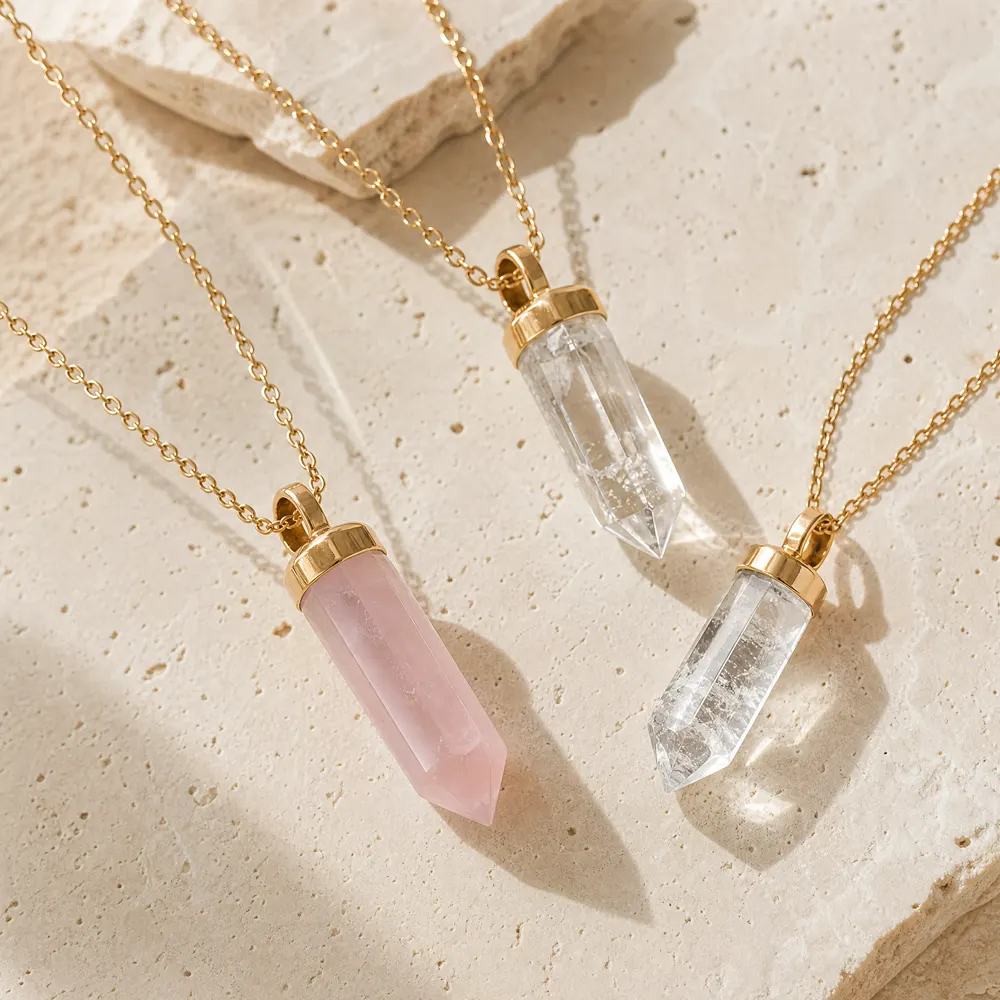
Answer first
Before asking for a quote, a buyer should be able to read one wholesale crystal jewelry line sheet and answer five questions: What is the exact SKU? What is it made of and how is each material described? Which images show the item and its scale? Which variants belong to the same family? What information or documentation still needs confirmation? Build the sheet around a unique product record, plain-language material declarations, controlled images, variant logic, and a short buyer brief. Keep commercial and technical items that are not confirmed—such as price, minimum order quantity, lead time, availability, origin, treatment status, testing, logistics or delivery—explicitly subject to written quotation, applicable requirements, documentation and approved sample. [1] [2]
Start with a line sheet that answers the buyer’s first decision
A wholesale crystal jewelry line sheet should make the first buying decision easier: whether the collection deserves a scoped request for quotation. It does not replace an approved sample or contract. Its job is to prevent a buyer from spending time decoding look-alike styles, vague material names or inconsistent images before the commercial discussion begins.
Use a versioned document with a collection name, issue date and contact route. Open with an assortment view, then give every item a repeatable record. Separate facts already documented from open questions. That separation is the most useful discipline in a crystal jewelry wholesale catalog: it avoids turning an illustration, a colour name or a supplier description into an unverified claim.
| Buyer decision | Line-sheet evidence | Appropriate next step |
|---|---|---|
| Is this a distinct item? | Unique SKU, category and item image | Add it to a scoped buyer brief. |
| Can it sit in the planned assortment? | Family, variant and styling relationship | Compare it with adjacent styles. |
| Can the description be reviewed? | Declared material and crystal terminology | Ask targeted documentation questions. |
| Is a quote request ready? | Quantity assumptions and open-item list supplied by buyer | Request a written quotation; do not infer unconfirmed terms. |
Buyer checklist
- Give the document a collection name, version number and issue date.
- Assign one stable internal style or SKU identifier to every sellable item.
- State the intended category and buyer channel context, if known.
- Mark information that is pending written quotation, documentation or approved sample.
- Provide a revision/contact route so a buyer does not work from an obsolete sheet.
Make every SKU a usable product record, not just a product name
A buyer needs a SKU record that survives copying into a buying system. At minimum, place the SKU beside a clear product name, product type, collection or family, variant identifier, and a concise silhouette description. If a necklace, earring, bracelet, ring, charm or set has a related style, show the relationship rather than making the buyer infer it from photography. A model number alone does not communicate whether two images show the same item in different finishes or two separately selectable items.
Add dimensions and weight only where they are documented and indicate the measurement basis and tolerance policy if one is provided. Avoid using one generic size statement for a family of variants. A pair, a single earring, a set and a multipack need unambiguous unit language. If measurements, fit, component count or variant mapping have not been confirmed, flag them for confirmation against the approved sample rather than filling the cells with estimates.
| Field | Why the buyer needs it | Control question |
|---|---|---|
| SKU | Links imagery, quote request and later product records | Does one identifier map to one selectable item? |
| Variant code | Distinguishes colour, finish or size alternatives | Is each selectable variant separately identified? |
| Selling unit | Avoids confusion between single, pair and set | What exactly is included in one unit? |
| Dimensions | Supports assortment and display planning | Are the measure points and units stated? |
Buyer checklist
- Stable SKU or style code.
- Plain product type and selling-unit description.
- Collection/family and variant relationship.
- Documented dimensions with unit and measurement basis, where available.
- Documented item weight with unit and basis, where available.
- Open-field marker where an approved sample or documentation is still required.
Declare crystal and jewelry materials with disciplined terminology
Material language is where a visually attractive wholesale jewelry collection sheet can become risky. List the declared metal or base material, the declared plating or finish where applicable, the crystal or stone descriptor, and any non-crystal components such as glass, resin, enamel, pearl or textile. Keep the exact wording consistent across the SKU row, image caption and any digital export. Do not use words such as “natural,” “genuine,” “gemstone,” “crystal,” “laboratory-grown,” “simulated” or a named stone casually or interchangeably.
For U.S.-facing product descriptions, the current FTC Jewelry Guides address treatment disclosure when treatment is non-permanent, creates special-care needs or significantly affects value; they also set rules on clearly qualifying laboratory-grown and imitation gemstone terms. GIA likewise requires submitters to disclose knowledge or suspicion of treatment or laboratory growth for material submitted to its laboratory. These sources do not turn a line sheet into a laboratory report. They support a buyer’s request for precise, documented terminology and a clear escalation path for treatment or identity questions.
Buyer checklist
- Use the same declared material wording in every SKU and image caption.
- Identify non-crystal components rather than hiding them in a generic “mixed materials” label.
- Separate observed look or colour naming from material identity.
- Request written disclosure and supporting documentation for treatment, laboratory-grown or imitation status when relevant.
- Link care statements only to documented characteristics or approved instructions.
- Do not make health, healing, medical or wellness outcome, spiritual, energy or feng-shui claims.
Use photography to show identity, scale and variation—not to guess specifications
A buyer cannot judge an assortment from a single editorial image. Each important SKU should have a clean primary image that can be matched to its code, plus close views that show the relevant construction or crystal placement. Include an in-context scale image only when it is clearly labelled as illustrative. A consistent background, crop and image naming scheme help a brand team transfer records into a product-information system without losing the SKU link.
Photography should never be used to establish unverified material, plating, colourfastness, stone identity, treatment status or exact dimensions. Colour rendering varies across screens and production lots may require approved-sample comparison. If an image contains multiple items, caption each item or provide an annotated overview. If a finish, crystal colour or component is a selectable variant, present its code next to the image instead of asking the buyer to choose by visual resemblance alone.
Buyer checklist
- Primary image named with the exact SKU.
- Detail image for construction, setting or crystal placement where relevant.
- Variant image and variant code kept together.
- Annotated group image when more than one SKU appears.
- Illustrative styling or scale images clearly labelled.
- Image revision controlled with the same document version as the line sheet.
Show the assortment logic so a buyer can build a coherent edit
Buyers purchase a commercial edit, not a random list of attractive products. Organise the line sheet by collection story, product category, visual family and variant architecture. A concise “anchor / supporting / add-on” role can be useful when it describes merchandising intent rather than a promised sales outcome. For example, a crystal focal pendant, its coordinating earrings and a related bracelet can be grouped as a visual family while retaining separate SKUs and separate open questions.
Use consistent filtering fields: category, silhouette, dominant colour description, declared finish, crystal descriptor, price-position field only when formally quoted, and status. Do not confuse an assortment role with a demand forecast. A buyer can then remove duplicates, identify gaps and prepare a narrower buyer brief. Any proposed quantities, price, MOQ, availability, lead time, delivery or logistics terms remain subject to a written quotation and should not be inferred from collection placement.
| Assortment view | Best when | Data the line sheet must retain |
|---|---|---|
| By category | The buyer is filling a known product mix | SKU, selling unit, dimensions and variant map |
| By visual family | The buyer is building coordinated stories | Cross-SKU relationships and declared finishes |
| By variant | The buyer needs controlled colour/finish choices | Variant code, image and exact material wording |
| By buyer shortlist | The buyer is preparing a quote request | SKU list, assumptions and unresolved documentation questions |
Buyer checklist
- Group related styles into visible families without collapsing their SKUs.
- Give each family a concise visual or category rationale.
- Separate variants from separate products.
- Use consistent assortment fields.
- Mark discontinued, draft or unconfirmed status only when documented; otherwise use an open-question marker.
- Let the buyer create a short list without implying commercial availability.
Put compliance and traceability prompts into the buyer brief
A line sheet should help route compliance work; it should not make compliance claims it cannot substantiate. For products within scope placed on the EU market, the General Product Safety Regulation includes product identification and manufacturer contact-information requirements, with information on packaging or an accompanying document where product size or nature makes placement unsuitable. It also addresses instructions and safety information where needed. Treat these as prompts to assemble an applicable market file, not as a substitute for checking the product and route with qualified advisers.
Build a small per-SKU “evidence requested / received / not applicable / pending” area. This can include material declarations, treatment disclosures where relevant, product identifiers, warnings or care information where applicable, responsible-operator details where applicable, and market-specific review status. CIBJO describes its Blue Books as voluntary, annually reviewed standards and nomenclature resources; they can be a useful vocabulary reference, while mandatory requirements and contractual specifications still need separate review.
Buyer checklist
- Record the target sales markets and channels for the buyer’s intended review.
- Retain a product identifier tied to the SKU and its current image.
- List which declarations, instructions, warnings or contacts are applicable, pending or not applicable.
- Separate supplier statements from third-party documentation.
- Check applicable requirements and qualified advisers before market placement or consumer-facing claims.
- Keep document versions and approved samples linked to the SKU.
Turn the completed sheet into a clean quote request
The best final page is a buyer brief, not a guessed quotation. It should list the selected SKUs and variants, the target market or channel, intended timing for review, desired documentation questions, and any sample-approval criteria the buyer wants to use. Use a separate field for questions that affect product description, such as component identity, treatment disclosure, measurement basis or care instructions. This gives the supplier a finite list to answer in writing.
Keep commercial fields explicitly conditional. A buyer may ask for price, MOQ, lead time, stock or availability, capacity, logistics or delivery options, packaging, display support, testing, certifications, origin, warranty or after-sales details, but none should be populated or assumed without written quotation, applicable documentation and approved sample where relevant. This protects both the buyer’s internal workflow and the accuracy of the eventual product record.
Buyer checklist
- Selected SKU and variant list attached to the same line-sheet version.
- Target market/channel and intended use stated by the buyer.
- Clear list of technical, material and disclosure questions.
- Sample-approval criteria stated where a sample will be reviewed.
- Commercial requests separated from confirmed product facts.
- Written quotation, applicable documentation and approved-sample dependencies recorded.
Frequently asked questions
Is a wholesale crystal jewelry line sheet the same as a catalog?+
Not necessarily. A catalog may be presentation-led and broad; a quote-ready line sheet is SKU-led and controlled. It should connect each image, variant and declared material description to a product record, while making unknown commercial or technical details visibly subject to written quotation, documentation and approved sample.
Should a line sheet state whether crystals are natural, treated or laboratory-grown?+
It should use only terminology supported by current documentation and request written disclosure where that status matters. Do not infer identity or treatment from an image, trade name or colour. The FTC Jewelry Guides and GIA disclosure guidance show why clear treatment and laboratory-grown disclosure questions belong in the buyer’s review.
What is the minimum image set for a buyer?+
Use one SKU-linked primary image, relevant detail views, coded variant images and an annotated group image if several products appear together. An illustrative scale or styled image can help merchandising, but it must not substitute for documented dimensions, materials or approved-sample review.
Can a buyer request commercial terms from the line sheet?+
Yes. The line sheet should make the request specific by listing the chosen SKUs, variants, target market and questions. Price, MOQ, timing, availability, logistics, testing, packaging and similar commercial or technical matters should remain subject to written quotation, applicable requirements, documentation and approved sample; the sheet should not imply them.
Conclusion
A strong wholesale crystal jewelry line sheet earns the quote request by making identity, declared materials, images, variants, assortment role and open compliance questions easy to review. Treat it as a version-controlled evidence map: facts are linked to SKUs; uncertainties are named; commercial and technical terms are confirmed only through written quotation, applicable documentation and approved sample. That gives retail buyers, brand teams, importers and sourcing partners a cleaner starting point for a responsible, market-specific review.
Product category references
Explore relevant GemMira formats.
Next step
Move from general guidance to your specific brief.
For a GemMira wholesale, private-label, or custom inquiry, share the product category, market, material direction, and any available reference images. Commercial terms, final specifications, and sample options are confirmed in a quotation and approved pre-production sample. Email your requirements to info@gemmira.com.
Start an inquiry with this guide →Email info@gemmira.com