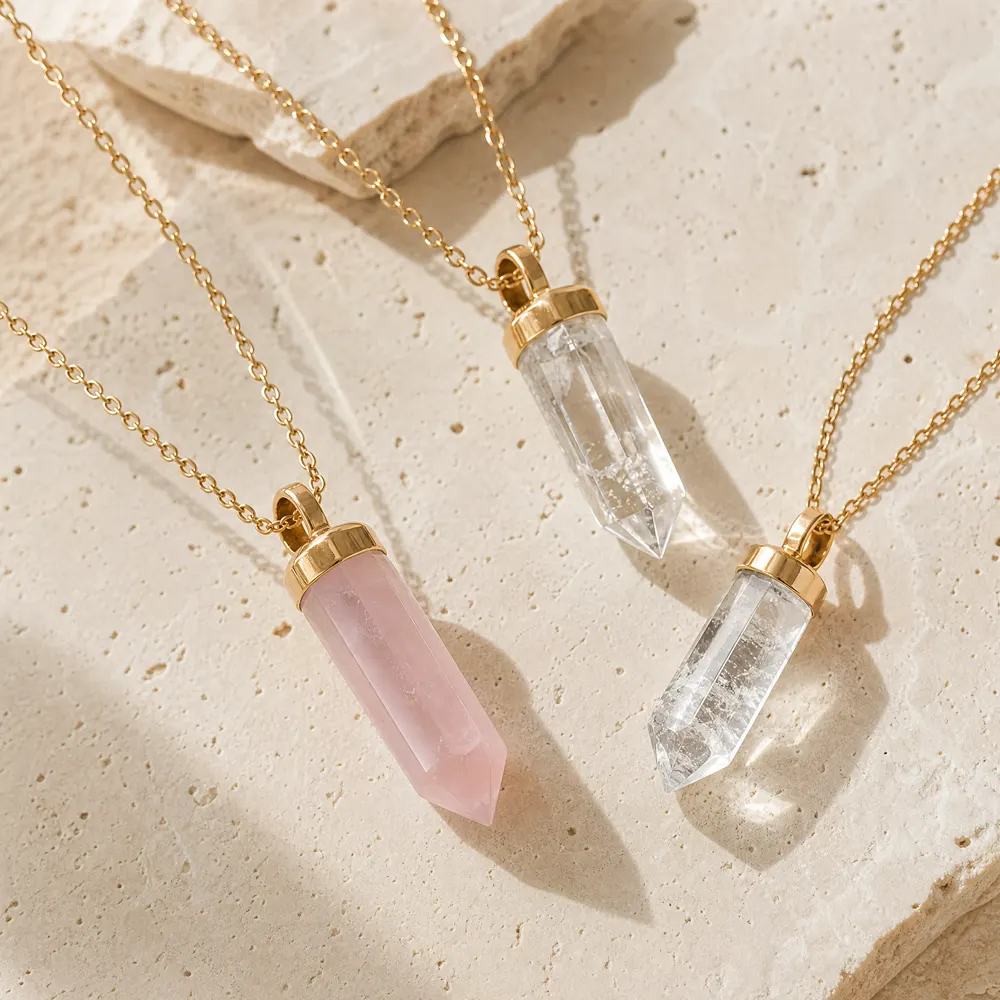
Answer first
A crystal jewelry sample request email should identify the exact styles, intended market and sample purpose; request a written response on material description, dimensions and measurement points, finish, component construction, representation or treatment information where relevant, available product records, sample terms, and approval criteria. Attach annotated references, state what will be checked, and keep every commercial or technical point subject to written quotation, applicable requirements, documentation, and the approved sample. [1] [2]
1. Begin with a controlled sample brief, not a vague enquiry
A useful first email lets the supplier identify the item and lets your team judge the reply. Give each requested item a buyer reference or provisional SKU, name the category (pendant, drop earring or bead bracelet), state the number of variants, and attach one labelled reference image or drawing per variant. Mark what is a visual reference, what is a must-have requirement, and what remains open for the supplier to confirm.
State the purpose of the sample: range selection, photography review, construction review, internal approval, or pre-production reference. The purpose changes the evidence you need. For example, a photography sample may need accurate visible colour and dimensions, while a construction review needs clear component, clasp, setting and assembly information. Do not describe a reference image as an approved specification if it is only inspiration.
Name the destination market or markets and the selling configuration you intend to evaluate, such as individual item, pair, or set. This does not decide legal compliance or customs treatment; it tells the supplier which questions need a written response and allows your importer, broker or compliance adviser to assess applicable requirements.
Buyer checklist
- Assign a buyer reference or provisional SKU to every requested sample.
- Attach labelled images or a drawing, with annotations tied to each buyer reference.
- State category, variant count, colourway and the intended selling unit.
- State the sample purpose and the internal reviewer or approval owner.
- Name intended destination market(s) and intended retail channel(s).
- Separate fixed requirements from points requiring confirmation.
- Request a written reply that mirrors the buyer references, rather than a general catalogue response.
2. Specify the product facts that must be confirmed in writing
Ask for a plain, component-level description rather than relying on a collection name. Separate the crystal or stone-like element, metal base, plating or coating, chain or cord, clasp, findings, adhesive or other relevant construction elements. Ask for the proposed colour name alongside images in normal lighting, but treat images as review evidence rather than proof of a material or treatment claim.
Request finished dimensions with declared measurement points: for a pendant, for example, pendant height and width, chain length and the point from which each is measured. For earrings, specify whether the requested quantity is one earring or a pair and ask for drop length from the agreed point. For bracelets, distinguish wearable inner circumference from overall laid-flat length. If your specification has tolerances, provide them; otherwise ask the supplier to state the measurement method and any proposed variation for approval.
Words such as gold, gold plated, vermeil, natural, treated, crystal and gemstone should not be filled in from assumption. The U.S. FTC Jewelry Guides address misleading descriptions of gold and gold plating, including qualified descriptions for surface-plated items. Ask for the exact proposed material and finish description, then have the wording reviewed for the markets in which it will be used. Where a gem material is represented, request available information about treatments and any associated care information; GIA notes that treatments can alter appearance or durability and may not be evident by sight.
Buyer checklist
- Request a component-level material and finish description.
- Define each dimension and its measurement point.
- Clarify item, pair and set quantities for every SKU.
- Ask for proposed consumer-facing material and finish terminology.
- Ask whether treatment or special-care information is relevant and what supporting documentation is available.
3. Match the evidence request to the sample decision
The email should ask for evidence that is proportionate to the decision you are making now. Do not demand a certificate, test report or origin statement that you have not defined or that the supplier has not offered. Instead, identify the market, the claim you expect to make, the document or record you need to review, and who will decide whether it is sufficient.
For goods placed on the EU market, Regulation (EU) 2023/988 requires manufacturers, subject to its scope, to provide a product type, batch or serial number or other identification element, and to provide manufacturer contact information on the product, packaging or an accompanying document where appropriate. A sample email can therefore ask how the proposed SKU or batch-identification route would be documented, but it should not presume a mark, responsible person, or compliance outcome before the applicable requirements and product design are assessed.
For a U.S.-bound commercial shipment, CBP says an invoice should accompany commercial shipments and calls for a full, accurate English description, quantity, purchase price and country of origin among the requested declaration information. Ask early for the factual product description and origin information that may be needed later, but do not ask anyone to select a tariff classification, value, or origin declaration without the importer and customs process confirming it.
| Decision at sample stage | Include in the email | Keep open until verified |
|---|---|---|
| Visual and range fit | Reference image, colourway, visible finish, dimensions and selling unit | Final product photography, colour naming and consumer copy |
| Construction review | Components, closure or setting points, intended use and inspection points | Final durability conclusion, test scope and acceptance result |
| Market-readiness review | Destination market, desired claims, available records and proposed identification route | Applicable legal duties, labelling language, markings and document sufficiency |
| Import planning | Potential destination, factual product description, quantities and origin information requested | HS classification, customs value, duty, entry method and clearance outcome |
Buyer checklist
- Connect each evidence request to a named approval decision.
- Ask what document or record is available; do not assume one exists.
- Keep customs classification and duty treatment with the importer or qualified customs adviser.
- Record the intended market and document reviewer for each sample.
4. Put the approval standard and exception process in the first email
A sample is only useful when the reviewer knows what constitutes an approval, a conditional approval, or a rejection. Put the review window, decision owner, response format and version-control rule in the request. Ask the supplier to identify any departure from the brief before dispatch, using the buyer reference and a photo or written note. This is more reliable than discovering a substitution during review.
Build the review around observable points: item configuration; visible finish; component count and placement; agreed measurement points; function of clasp or fastening where applicable; surface condition; and the alignment of any proposed description with the facts supplied. Record findings against the exact sample and date. A visual preference, a manufacturing issue, and a missing document should be logged as different types of finding.
Use the approved physical sample and its written record as a reference only after both sides have confirmed what it represents. Approval of one visible attribute does not automatically approve another attribute, future production, a retail claim, or a regulatory conclusion. Any revisions, alternative materials, treatments, processes or components should return to written review before being treated as accepted.
Buyer checklist
- Name the approval owner, response deadline and decision labels.
- List the inspection points and the expected evidence for each.
- Require pre-dispatch disclosure of deviations from the brief.
- Log sample identifier, receipt date, reviewer and decision.
- State that changes require written review and must not be inferred from silence.
5. Ask about sample terms without inventing commercial commitments
Keep the commercial part of the email as questions. Ask whether a sample can be supplied for the requested configuration; what sample charge, shipping charge, taxes or other costs may apply; what payment method is required; whether any later order credit is offered; and what dispatch timing, delivery arrangement and Incoterms, if any, are proposed. Request a written quotation or pro forma response that identifies the exact sample references and the validity of the offer.
Do not assume MOQ, unit price, available stock, production capacity, lead time, sample fee credit, packaging configuration, courier, insurance, customs clearance, delivery date or warranty. Those details are commercial or logistical matters to be confirmed in writing. Likewise, do not call a sample a production-approved sample until its status has been agreed and recorded.
Give a complete delivery contact, phone number for carrier use where appropriate, and address format, but do not ask the supplier to understate value or misdescribe merchandise. The importer remains responsible for the accuracy and admissibility of the import process in the relevant jurisdiction. Build time for your broker or compliance review where the sample route or documentation warrants it.
Buyer checklist
- Request written sample availability and a quotation tied to buyer references.
- Ask which sample, freight, tax and payment items may apply.
- Ask for the proposed dispatch arrangement; do not assume a delivery promise.
- Provide complete receiving details and a nominated customs or logistics contact where applicable.
- State that invoice, declaration and origin information must be accurate and reviewed through the import process.
6. Use an email format that makes a useful reply easy
A short, structured email is better than a long narrative. Use a precise subject line, a one-sentence request, then a numbered list that follows the attachments. Put the required reply fields directly in the body so the supplier can answer line by line. Keep internal target retail prices, sales forecasts and unapproved marketing claims out of the first sample request unless they are essential to the stated decision.
Suggested email body: "Subject: Sample request — [buyer reference / category]. Hello, we are requesting review samples for the attached references for [sample purpose] and intended market(s) [market]. For each reference, please confirm: (1) proposed component-level material and finish description; (2) crystal or stone-like material description and any treatment or care information relevant to the representation; (3) finished dimensions, measurement points and item/pair/set configuration; (4) images of the proposed sample; (5) available product, traceability or compliance records relevant to the stated market; (6) any deviation from our annotated reference; and (7) proposed sample quotation, charges, payment terms and dispatch arrangement. Our review points are [list], and our decision owner is [name]. Please identify your reply and any sample with our buyer reference. All commercial and technical details remain subject to written quotation, applicable requirements, documentation, and approved sample. Thank you."
Before sending, remove brackets, ensure every attachment is named with its buyer reference, and make the request internally reproducible. Save the sent email, attachments, reply, quotation, images, receipt record and approval decision together. That file becomes a practical handover record without claiming that it alone proves regulatory, customs or product conformity.
Buyer checklist
- Use a subject line containing the buyer reference and sample purpose.
- Make the supplier response fields numbered and answerable line by line.
- Attach only current, labelled reference files.
- Repeat the intended market and approval points in the email body.
- Archive the complete email-and-sample record with the final decision.
Frequently asked questions
Should a crystal jewelry sample request email ask for a certificate?+
Ask what records or documents are available and explain the market and claim you need to assess. Do not assume that a particular certificate, test, certification or laboratory result exists or is sufficient. Define the review owner and confirm adequacy against applicable requirements before relying on it.
How should a buyer describe a crystal when the exact material is not yet confirmed?+
Use neutral wording such as “crystal or stone-like element—please confirm proposed material description.” Attach the visual reference and ask for the supplier’s written description, treatment information where relevant, and proposed consumer-facing terminology. Do not convert a visual appearance into a natural, untreated or origin claim without support.
Do samples need the same markings and documentation as a retail shipment?+
The answer depends on the product, destination, shipment route and applicable law. Identify the sample as a sample accurately, ask what information can accompany it, and have the importer or relevant adviser assess the route. For later EU consumer-market placement, the GPSR product-identification and economic-operator requirements should be considered; for U.S. imports, origin-marking and invoice requirements can also be relevant.
Can sample approval lock in the final order specification?+
Only if the written approval record identifies precisely what is approved and the parties agree to use it as a reference. A sample does not by itself establish price, MOQ, capacity, timing, legal compliance, shipment outcome, material treatment status or future production consistency. Confirm those points separately in written commercial and technical documentation.
Conclusion
The strongest crystal jewelry sample request email is a compact procurement brief: it gives each requested item an identity, separates confirmed requirements from open questions, requests evidence proportionate to the decision, and records how approval will be made. This approach reduces avoidable ambiguity while leaving quotation-dependent, customs, regulatory and technical conclusions to the appropriate written review.
Product category references
Explore relevant GemMira formats.
Next step
Move from general guidance to your specific brief.
For a GemMira wholesale, private-label, or custom inquiry, share the product category, market, material direction, and any available reference images. Commercial terms, final specifications, and sample options are confirmed in a quotation and approved pre-production sample. Email your requirements to info@gemmira.com.
Start an inquiry with this guide →Email info@gemmira.comReferences
- U.S. Federal Trade Commission — Jewelry Guides, 16 CFR Part 23
- European Union — Regulation (EU) 2023/988 on general product safety
- U.S. Customs and Border Protection — Internet Purchases (declaration and commercial-shipment information)
- U.S. eCFR — Country of Origin Marking, 19 CFR Part 134
- Gemological Institute of America — An Introduction to Gem Treatments