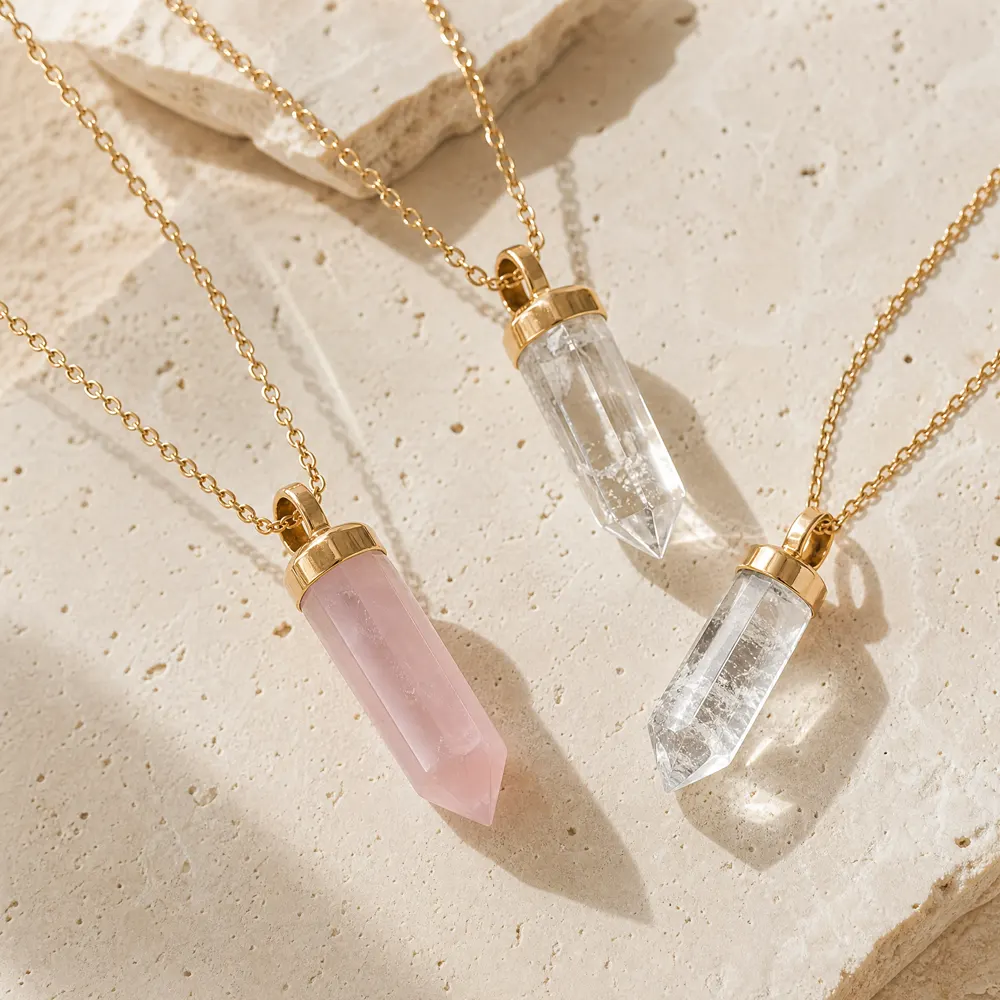
Answer first
Compare materials by four copy-critical facts: what the material is, how it was produced, whether it was treated or combined with filler or binder, and what care or documentation can be substantiated. Put the qualifier next to the material name—for example, ‘natural quartz,’ ‘laboratory-created synthetic corundum,’ ‘imitation glass crystal,’ or ‘treated stone’—rather than relying on a vague label such as ‘crystal.’ For Europe, North America, and the Middle East, review final wording against destination-market requirements. Unknown GemMira commercial and technical details are subject to written quotation, applicable requirements, documentation, and approved sample. [1] [2]
1. Start with a material taxonomy
Establish whether the visible component is a natural mineral or gemstone, a laboratory-created material, an imitation, or a treated or composite product. GIA describes synthetic gem material as laboratory-made and sharing virtually all chemical, optical, and physical characteristics with its natural mineral counterpart; that differs from an imitation category.
Use the most specific substantiated term available. If species, production route, treatment, filler, binder, or evidence is unconfirmed, hold stronger public wording.
| Category | Copy should explain | Avoid unless substantiated |
|---|---|---|
| Natural | Named material and relevant treatment | Untreated, rare, or origin claims |
| Laboratory-created | Laboratory origin | Mined or natural |
| Imitation | Resemblance and non-mined status | Using ‘faux’ alone |
| Treated/composite | Treatment or construction and care | Unqualified gemstone name |
Buyer checklist
- Name the actual component or leave it open pending written confirmation.
- Separate natural, laboratory-created, imitation, treated, and composite categories.
- Record evidence supporting each term.
- Do not infer composition or origin from appearance alone.
2. Compare attributes buyers need
Compare identity, production category, appearance, dimensions, weight, cut or shape, setting, and wearer-contact components. Keep subjective phrases such as ‘soft pink’ or ‘high sparkle’ separate from composition and performance claims.
If color, clarity, or pattern varies by batch, state that and define the approved reference sample or tolerance. Unknown GemMira testing, certification, origin, treatment, and performance details remain subject to written quotation, applicable requirements, documentation, and approved sample.
| Field | Buyer question | Evidence |
|---|---|---|
| Identity | What exactly is visible? | Material declaration |
| Production | Natural, laboratory-created, imitation, treated, or composite? | Written declaration or report |
| Appearance | What varies? | Approved sample |
| Care | Any limitations? | Care guidance |
Buyer checklist
- Compare the same fields across options.
- Distinguish visual descriptors from technical claims.
- State whether measurements are nominal or measured.
- Link claims to a document or approved sample.
- Flag claims requiring market review.
3. Put qualifiers next to the material name
The FTC Jewelry Guides and eCFR say laboratory-created and imitation or simulated qualifiers should be clear, conspicuous, and immediately associated with the named stone. Avoid unqualified natural-stone names and do not use ‘faux’ as the only disclosure.
Apply this discipline to titles, bullets, filters, image text, packaging, catalogs, marketplaces, and translations. ‘Laboratory-created quartz pendant’ communicates more than ‘quartz pendant’ followed by a distant footnote.
| Risky shorthand | Controlled pattern |
|---|---|
| Quartz crystal necklace | Natural quartz necklace—treatment status subject to confirmation |
| Synthetic ruby look | Laboratory-created ruby, if comparable properties are substantiated |
| Faux gemstone | Imitation [material], not a mined stone |
| Treated emerald | Treated [material], with applicable care information |
Buyer checklist
- Put natural, laboratory-created, imitation, simulated, or treated beside the material name.
- Repeat status in short online copy.
- Check translations for equivalent meaning.
- Review images, metadata, and packaging.
- Do not use real, genuine, or natural for artificially produced products.
4. Disclose treatments, composites, and care
Treatments can change color, clarity, durability, care needs, or perceived value. FTC and eCFR identify disclosure concerns where treatment is not permanent, creates special care requirements, or significantly affects value. For online and catalog sales, relevant disclosure belongs in the product description.
Ask the supplier to state treatment and care implications in writing. For filler or binder products, do not collapse construction into the name of a natural gemstone. If status is unknown, do not imply ‘untreated.’
| Situation | Copy decision |
|---|---|
| Not permanent | State treatment and possible change |
| Special care | State treatment and care |
| Affects value | Disclose treatment |
| Filler or binder | Describe construction and different characteristics |
Buyer checklist
- Ask about coating, impregnation, filling, heating, irradiation, or dyeing.
- Identify fading or special cleaning requirements.
- Check whether filler or binder changes characteristics.
- Place care instructions with product information.
- Retain the written statement with the SKU record.
5. Build region-aware copy controls
FTC sources are U.S.-focused, while EU consumer-protection rules address misleading actions and omissions about main product characteristics. Middle Eastern markets vary by country, language, platform, and importer obligations. Use the strictest substantiated wording that remains accurate, then confirm destination requirements with the importer, marketplace, or local adviser.
For Europe, preserve material identity and main characteristics in the required language and format. For North America, check FTC, federal, state, provincial, marketplace, and customs rules. For the Middle East, plan Arabic and English review where relevant.
| Context | Priority | Do not assume |
|---|---|---|
| Europe | Clear main characteristics | One wording resolves every national rule |
| North America | Qualifiers and treatment disclosure | A distant disclaimer is enough |
| Middle East | Country and language review | Translation preserves legal meaning automatically |
Buyer checklist
- Identify destination countries before final copy.
- Map terms to local-language equivalents.
- Check headline, image, filter, packaging, and marketplace fields together.
- Confirm documentation with the responsible operator.
- Escalate origin, treatment, safety, or performance claims.
6. Turn comparison into a controlled SKU brief
Create one record per SKU with exact material wording, prohibited alternatives, evidence, approved sample, care statement, and approved markets. This prevents a merchandising team from shortening ‘laboratory-created’ to ‘natural’ or carrying an unverified phrase into a marketplace title.
GemMira MOQ, pricing, lead time, capacity, certifications, testing, material origin, treatment status, stock, logistics, delivery, warranty, packaging capability, and customer outcomes are not stated here and are subject to written quotation, applicable requirements, documentation, and approved sample.
| SKU field | Controlled entry |
|---|---|
| Public material line | Laboratory-created [named material], subject to documented specification |
| Treatment line | Treatment status: [confirmed term]; care: [approved instruction] |
| Evidence | Supplier declaration, report, or sample reference |
| Market scope | Approved countries and channels pending local review |
| Change control | Reconfirm after material or sample change |
Buyer checklist
- Create one material statement per SKU and variant.
- Attach source documents and sample reference.
- Record prohibited shorthand and mandatory qualifiers.
- Assign market and translation review ownership.
- Re-approve after any material or sample change.
Frequently asked questions
Can a product simply be called ‘crystal jewelry’?+
Use it as a broad collection label only when the SKU description identifies the component material and relevant production or treatment status. It should not replace a clear product description.
Is synthetic the same as imitation?+
No. GIA uses synthetic for a laboratory-made material sharing virtually all chemical, optical, and physical characteristics with its natural counterpart. Imitation is a look-alike category and should not be presented as the named mined material.
What if treatment status is unconfirmed?+
Do not write ‘untreated’ or imply a natural, permanent, or uniform result. Request written confirmation and care guidance, and publish only a neutral statement that can be substantiated.
Can copy mention energy, healing, or feng-shui benefits?+
Do not present wellness, healing, medical or wellness outcome, medical, spiritual, energy, or feng-shui efficacy as a verified benefit. Cultural or design context may be described without claiming that jewelry produces an effect.
Conclusion
The strongest crystal jewelry material comparison copy is specific, adjacent, and evidence-led. Name the category, qualify laboratory-created or imitation products beside the material name, disclose relevant treatments and care, and keep regional review in the workflow. When GemMira details are unknown, rely on written quotation, applicable requirements, documentation, and approved sample.
Product category references
Explore relevant GemMira formats.
Next step
Move from general guidance to your specific brief.
For a GemMira wholesale, private-label, or custom inquiry, share the product category, market, material direction, and any available reference images. Commercial terms, final specifications, and sample options are confirmed in a quotation and approved pre-production sample. Email your requirements to info@gemmira.com.
Start an inquiry with this guide →Email info@gemmira.com